Problem
Generic dashboard caused high trial churn (78% drop-off) and forced sales teams to manually build custom demos.

An all-in-one business management platform for small and medium businesses across India.
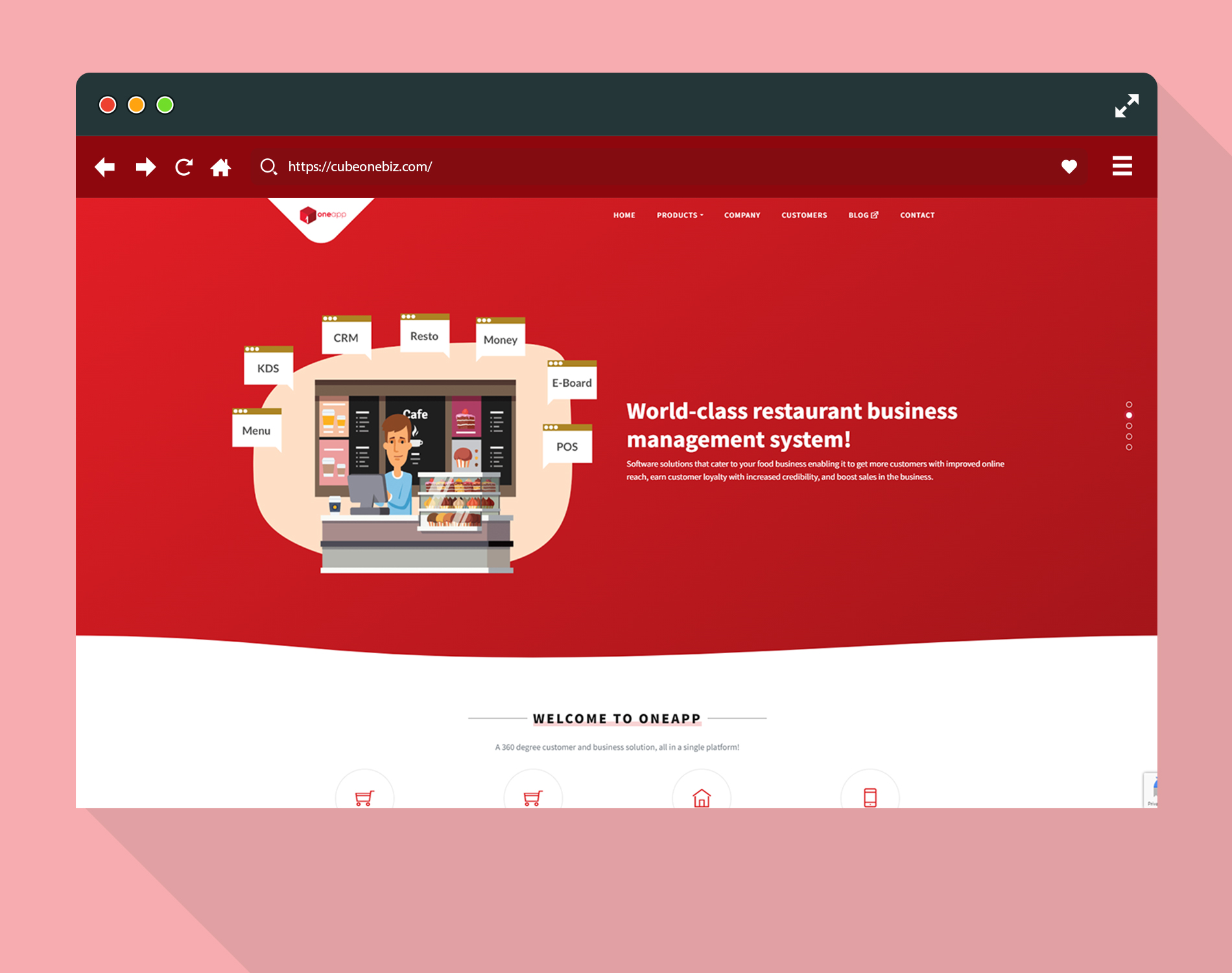
CubeOneBiz is an all-in-one business management platform developed by Futurescape Technologies, targeting small and medium businesses across India — restaurants, retail shops, tiffin services, and housing societies. The product aggregates separate tools — POS, billing, inventory, CRM, and gate security — into a single application. I led the complete redesign of onboarding, the adaptive business dashboard, CRM, and workflow builder.
CubeOneBiz had a classic SaaS problem: too many features, not enough clarity. Only 22% of trial signups reached the point of entering their first transaction because every business type landed on the exact same generic dashboard. Furthermore, the marketing homepage had a 74% bounce rate and failed to explain the core value proposition.
Generic dashboard caused high trial churn (78% drop-off) and forced sales teams to manually build custom demos.
An adaptive dashboard that personalizes the primary view based on business category (restaurant vs. retail vs. society).
Trial-to-first-transaction rose from 22% to 61%, bounce rate dropped from 74% to 31%, and report lookup time fell to 90 seconds.
Six usability sessions with existing customers across retail, restaurant, and residential management revealed significant time-on-task delays (e.g., 8 minutes to pull a sales report). A 5-second test on the old homepage showed only 10% comprehension.
Strategy became a re-framing of the entry moment: a restaurant owner must see today's orders immediately; a society secretary must see unpaid maintenance dues immediately. Same product, same data model — but the home screen has to be opinionated about who you are.
Onboarding captures the business type, and the dashboard reorders itself.
Reorganised navigation from product structure to user jobs (Today, Sales, Customers).
Built a tokenised component library for consistency across all modules.
Completely rewrote marketing copy to lead with concrete outcome metrics.
Re-architected reporting navigation to cut lookup time from 8 minutes to 90 seconds.
Replaced the one-size-fits-all view with domain-specific initial views.
Presents primary tasks upfront while allowing power-user customization.

personalises home screen based on business type.
contact management with purchase history and segmentation tags.
visual Kanban board for tracking leads and opportunities.
integrated point-of-sale with digital invoice delivery.
trigger-based automation rules for follow-ups.
team task assignment with priority tracking.
role-based staff accounts with permission controls.
unified queue for leads captured from web, manual entry, and WhatsApp.
stock level tracking with low-stock alerts.
revenue and acquisition metrics with date filters.
consolidated alert feed for payment confirmations.
manage multiple branches from one account.
exportable custom reports by date range and category.
essential sales actions on Android for field teams.
Trial-to-first-transaction completion rose from 22% to 61%, and homepage bounce fell from 74% to 31%. One product interface now seamlessly serves restaurant, retail, and housing-society segments.
Building opinionated defaults with flexible depth allowed us to serve multiple business domains without branching codebases. Investing heavily in a strict, tokenised design system early saved months of design debt later.